





Innovative large-scale equipment: Minister Willingmann and Richter present grant notifications to Magdeburg University Hospital
Investments from the COVID-19 Special Fund increase crisis resilience and strengthen research, teaching, and patient care.
Magdeburg University Medical Center (UMMD) held discussions today with the State of Saxony-Anhalt regarding three new, innovative large-scale medical devices that will be funded by the state’s COVID-19 Special Fund. Minister of Science Prof. Dr. Armin Willingmann and Finance Minister Michael Richter presented the official grant notifications totaling approximately 9.5 million euros and discussed the new technologies and their significance for research, teaching, and patient care, particularly in crisis situations.
To kick off the event, Prof. Dr. Hans-Jochen Heinze, Medical Director of Magdeburg University Hospital, welcomed those in attendance. On behalf of the entire hospital board, he expressed his gratitude to the State of Saxony-Anhalt for its support.
Willingmann said: “The investment from the State of Saxony-Anhalt’s special COVID-19 fund strengthens the medical infrastructure and the resilience of our healthcare system. The acquisition of this state-of-the-art equipment is more than just a technical upgrade; it also reflects our strategy to further develop healthcare in Saxony-Anhalt to be efficient, digital, and scientifically excellent. This benefits patients as well as research and teaching.”
Minister Richter: “During the COVID-19 pandemic, our state’s university hospitals have demonstrated how important an efficient and innovative medical infrastructure is. With targeted investments from the special COVID-19 fund, the state government has created the conditions to sustainably strengthen the resilience of our healthcare facilities. In doing so, we are laying the foundation for Saxony-Anhalt to continue playing a pioneering role in medical care, research, and teaching in the future.”
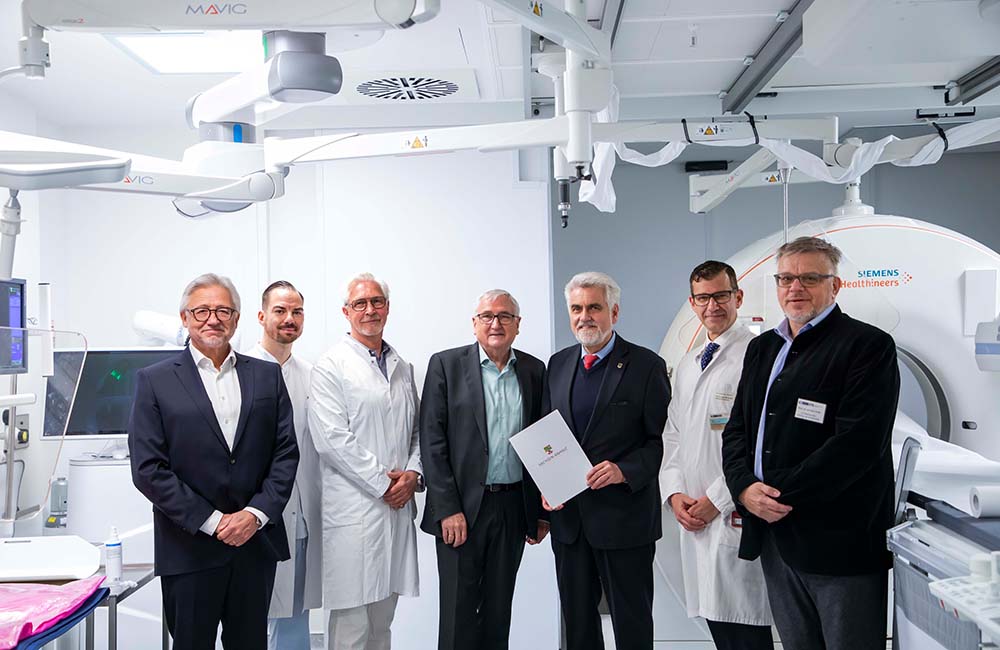
Photo: Minister of Science Prof. Dr. Willingmann (third from right) and Minister of Finance Richter (fourth from right) present grant awards to Magdeburg University Hospital. From left: Prof. Dr. Hans-Jochen Heinze, Medical Director of Magdeburg University Hospital; Dr. Mathias Becker, Executive Senior Physician; Prof. Uwe-Bernd Liehr, MD, University Clinic for Radiology and Nuclear Medicine; Prof. Michael Kreißl, MD, Acting Director of the Clinic for Urology and Uro-Oncology and Chief Physician of Nuclear Medicine (2nd from right); Privatdozent Dr. Oliver Großer, Senior Medical Physicist at the Department of Radiology and Nuclear Medicine. Photographer: Sarah Kossmann / UMMD
Following this, the experts presented three major pieces of funded equipment:
Greater flexibility through mobile units
Prof. Dr. med. Uwe-Bernd Liehr, Acting Director of the Department of Urology, Uro-Oncology, and Robotic and Focal Therapy in Magdeburg, focused his presentation on a central challenge facing modern hospital structures: In pandemic and mass casualty situations, existing processes quickly reach their limits. Infection risks rise, surgical capacities collapse, and medical training programs also come under pressure.
As a potential solution, he highlighted mobile, flexible, and universally applicable diagnostic and therapeutic systems. These enable the rapid spatial separation of patient flows, interrupt chains of infection within the hospital, and thus ensure surgical care even under crisis conditions.
A central component is a mobile unit featuring X-ray, ultrasound, and MRI fusion technology, which enables procedures to be performed directly at the site of operation and thus supports decentralized “satellite operating rooms.” Digital imaging with live transmission also ensures that training can continue without additional infection risk.
In the event of a mass casualty incident, the systems increase flexibility and reduce diagnostic bottlenecks. Overall, they strengthen the hospital’s resilience by enhancing its operational capacity and reducing dependence on central operating room structures.
Flagship Project in Nuclear Medicine
Prof. Michael Kreißl, MD, Chief of Nuclear Medicine at Magdeburg University Hospital, also emphasized that diagnostic bottlenecks can quickly limit care capacity, particularly in exceptional situations. Against this backdrop, he presented the whole-body PET/CT system with Long Axial Field of View (LAFOV), which, thanks to high sensitivity and rapid whole-body imaging (scans possible in less than a minute), enables significantly increased patient throughput, shorter examination times, and improved image quality. In pandemic situations, a highly precise search for sites of inflammation can be performed on many patients within a short time to enable targeted treatment. At the same time, this state-of-the-art diagnostic technology is available to cancer patients. Due to the significantly lower radiation exposure, children and young adults in particular also benefit from the new technology. In addition, optimal conditions are created for the training and continuing education of medical and technical staff.
Prof. Heinze emphasized: “The new infrastructure strengthens Magdeburg University Hospital and improves diagnostic and therapeutic options—especially under crisis conditions.”
Prof. Dieterich added: “The investments have an impact far beyond patient care: as a flagship project, they strengthen our research infrastructure, promote cross-site collaboration—for example with the DZNE, the Dessau Hospital, and the Halle University Hospital—and open up new development opportunities for medical technology, particularly within the context of the STIMULATE Research Campus.”
Innovation in Interventional Oncology
Dr. Oliver Großer, senior medical physicist at the Department of Radiology and Nuclear Medicine in Magdeburg, presented an interventional oncology imaging system that combines CT and angiography in a single unit on behalf of the department director, Prof. Dr. Maciej Pech. Here, too, the high relevance of robust and efficient workflows in crisis situations was emphasized, which enable stable and seamless care even during complex procedures and imaging.
The system will enable precise, minimally invasive procedures in a single environment, reduce the need for patient repositioning and time losses, and support high precision even under stress through needle tracking and optimized software. Overall, both technologies will contribute to enhancing clinical flexibility and the reliability of care in exceptional situations.