





Parliamentary Evening Hosted by the University Medical Centers of Magdeburg and Halle on June 1, 2026
University Medicine in Saxony-Anhalt: A Driving Force for Integrated Care, Innovation, and Securing the Workforce
Under the theme “University Medicine in Saxony-Anhalt – Translating Innovation, Securing Care,” the University Hospitals of Magdeburg and Halle (Saale) jointly hosted a Parliamentary Evening on the campus of the University Medicine Magdeburg. Representatives from politics, academia, healthcare, and civil society used the event to discuss the future of medical care in Saxony-Anhalt.
The focus was on the central role of university medicine in research, cutting-edge medicine, medical education, and ensuring care—especially in the geographically expansive state of Saxony-Anhalt. The event highlighted the outstanding importance of the Magdeburg and Halle sites as engines of innovation for modern medicine and as cornerstones of the state’s healthcare system.
The university medical centers assume responsibility for the state’s entire healthcare system far beyond the scope of maximum care—serving as scientific catalysts, drivers of innovation, training institutions, and coordinating partners for key regional care networks.
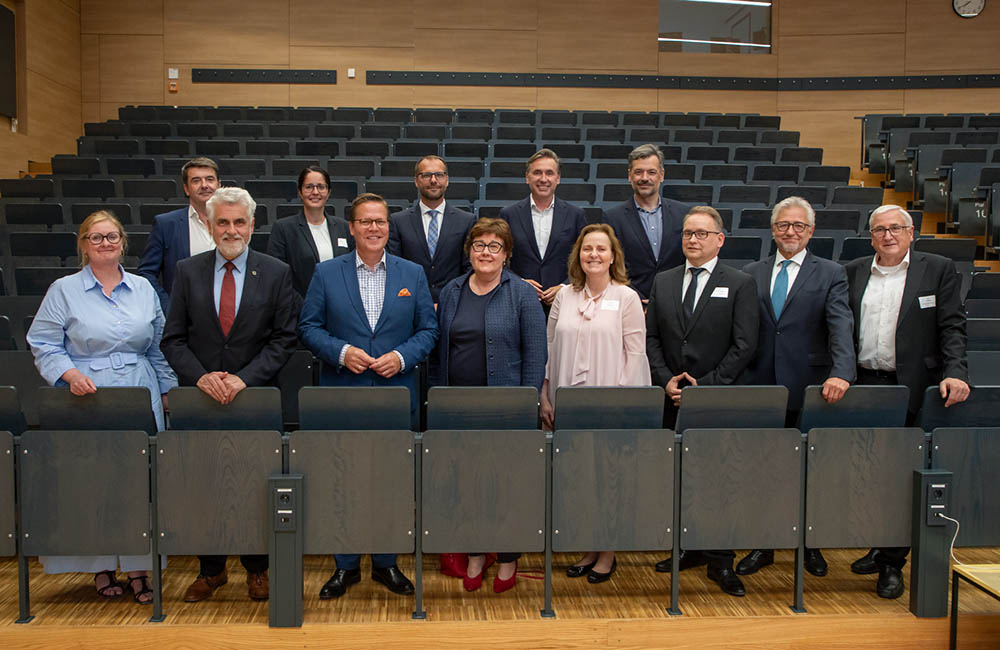
Photo: Parliamentary Evening hosted by Magdeburg University Hospital and Halle University Hospital on June 1, 2026, at Magdeburg University Hospital.
Front row, from left: Prof. Dr. Daniela Dieterich, Dean of the Faculty of Medicine at Otto von Guericke University Magdeburg; Prof. Dr. Armin Willingmann, Minister for Science, Energy, Climate Protection, and the Environment of the State of Saxony-Anhalt and Chair of the Supervisory Board of both university hospitals; Tino Sorge, Parliamentary State Secretary at the Federal Ministry of Health; Petra Grimm-Benne, Minister for Labor, Social Affairs, Health, and Equality of the State of Saxony-Anhalt, Prof. Dr. Heike Kielstein, Dean of the Faculty of Medicine at Martin Luther University Halle-Wittenberg, PD Dr. Matthias Janda, Medical Director of the University Hospital Halle (Saale), Prof. Dr. Hans-Jochen Heinze, Medical Director of Magdeburg University Hospital, Michael Richter, Minister of Finance of the State of Saxony-Anhalt.
Back row, from left: Prof. Dr. Maciej Pech, Director of the University Clinic for Radiology and Nuclear Medicine in Magdeburg; Christiane Becker, Director of Nursing Services and Member of the Executive Board of University Medicine Halle (Saale); Marco Bohn, Chief Financial Officer of Magdeburg University Hospital, Thomas Wünsch, State Secretary in the Ministry of Science, Energy, Climate Protection, and Environment of the State of Saxony-Anhalt, Alexander Beblacz, Chief Financial Officer of Halle (Saale) University Hospital. Photographer: Melitta Schubert / UMMD
The Minister of Science and Chairman of the Supervisory Board of both university hospitals, Prof. Dr. Armin Willingmann, emphasized the importance of the institutions:
“University medicine in Saxony-Anhalt stands for scientific excellence, medical progress, and responsibility for people’s healthcare. Research must not end in the laboratory—it must reach where it is needed: with the patients. Our university hospitals achieve this at the highest level. This is also because the state supports them during challenging times,” Willingmann emphasized, speaking in his capacity as Deputy Minister-President.
The event highlighted how closely research, cutting-edge clinical medicine, teaching, and regional healthcare are interconnected. Among other things, innovative approaches in the fields of prevention, robotics, AI-supported diagnostics, translational medicine, and modern network structures for community-based care were presented. Exhibits from the field of medical robotics, as well as presentations by selected departments, offered guests the opportunity to engage in direct dialogue with experts from both university hospitals during the subsequent get-together.
In the run-up to the Parliamentary Evening, representatives from politics and science had already visited the University Children’s Hospital in Magdeburg on Children’s Day. There, innovative projects were presented that exemplify the connection between research and care.
These include, among other things, AI-supported models for predicting disease progression in rare tumor diseases, a “digital twin” model for the early detection of respiratory failure in pediatric intensive care, and new approaches in pediatric prevention.
Dynamic page content: Gallery Parliamentary Evening, Client ummd
Prof. Dr. Hans-Jochen Heinze, Medical Director of the University Hospital Magdeburg, emphasized:
“University medicine is not a luxury, but an indispensable part of public services. We take responsibility for healthcare far beyond our own campus. In future-oriented fields such as brain health, AI-supported diagnostics, robotics, and cell-based therapies, we set standards in Magdeburg and actively drive medical innovation forward. At the same time, we are a significant economic and locational factor for Saxony-Anhalt, and by training highly qualified specialists, we are securing the future of medicine in our state. Especially in a large state like Saxony-Anhalt, there is a need for strong university medical centers that develop innovations and, together with regional partners, bring them into patient care.”
Prof. Dr. Daniela Dieterich, Dean of the Faculty of Medicine at the Otto von Guericke University Magdeburg, emphasized:
“Magdeburg is an internationally recognized hub for innovative university medicine. We are doing important pioneering work in many areas—from prevention and state-of-the-art medical technology to neuroscience and novel cell and immunotherapies. Of particular importance to us is the training of the next generation of medical professionals: the doctors, scientists, and healthcare professionals we are training today will play a decisive role in shaping and providing care in Saxony-Anhalt in the coming decades.”
PD Dr. Matthias Janda, Medical Director of the University Hospital Halle (Saale), explained:
“Our university medical center bears responsibility for the healthcare of people throughout Saxony-Anhalt—especially where diseases become complex and the highest level of specialization is required. In oncology, cardiac health, and geriatric medicine, we combine cutting-edge medicine with local care, making medical progress directly accessible to citizens. Through our partnership with the Bergmannstrost Klinikum Halle, we demonstrate how cross-sector collaboration ensures care and wisely pools resources—with emergency care that functions reliably even in the most severe cases. This makes us a medical anchor for Saxony-Anhalt and a reliable partner for the state’s health policy."
Prof. Dr. Heike Kielstein, Dean of the Faculty of Medicine at Martin Luther University Halle-Wittenberg, added:
“Medical care in rural areas is one of the most pressing challenges of our time—one that we are actively addressing. With the TPG project, we are testing new care models that consistently integrate telemedicine and ensure high-quality medical care for patients even outside major urban centers.
But innovative research and care require top talent: We are training the doctors and scientists of tomorrow—people who not only bring medical knowledge to the table but also the drive to actively rethink healthcare—because that is how we translate research into real-world care—for Saxony-Anhalt and as a model for all of Germany.”
The parliamentary evening also underscored the shared strategic focus of the two university medical centers: to translate scientific findings into clinical practice more quickly, to train highly qualified specialists, and to ensure modern medical care for people in all regions of Saxony-Anhalt.
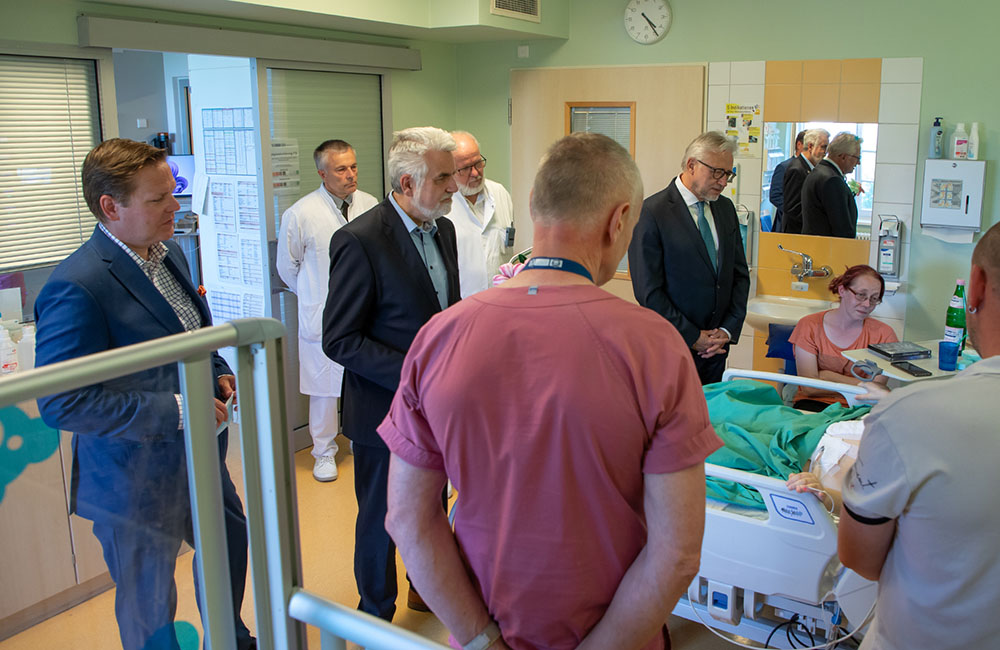
Photo: Visit to the pediatric intensive care unit at Magdeburg University Children’s Hospital. From left: Tino Sorge, Prof. Armin Willingmann, and Prof. Hans-Jochen Heinze visit the young patients together with the medical staff. Photographer: Melitta Schubert / UMMD