





Ten Years of the Master's Program in Immunology in Magdeburg
When the Master’s program in Immunology launched in Magdeburg in 2016, it was the first of its kind in Germany—a bold venture with just 13 students. Ten years later, this niche field has become a key discipline: cell and gene therapies are transforming cancer treatment, and few fields of medicine are evolving as rapidly.
On the occasion of its 10th anniversary, we take stock: Prof. Dirk Reinhold, M.D., who helped establish the program from the very beginning, and Prof. Stephan Fricke, M.D., who has headed the Institute for Clinical Immunology and Cell Therapies since October 2025, look back on the past, explain what the Nobel Prize in Medicine has to do with the program, and discuss the questions that will shape immunology in the coming decade.
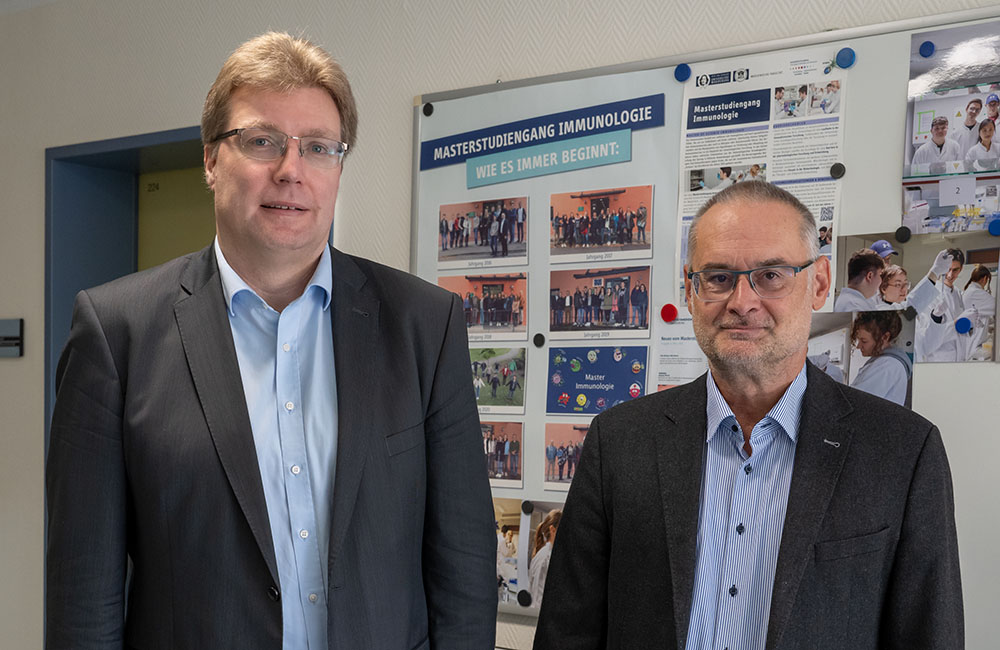
Photo (from left): Prof. Dr. med. Stephan Fricke and Prof. Dr. med. Dirk Reinhold. Photographer: Melitta Schubert / UMMD
Prof. Reinhold, do you still remember the launch of the master’s program in 2016 and the first 13 students?
Prof. Reinhold: Very well, in fact. Sitting before us were 13 young, eager people. After a long period of planning and preparation, an idea suddenly became reality. Of course, there were many organizational questions at first. Above all, however, we were overjoyed that the Master’s program in Immunology was actually launching in Magdeburg and that we could build something new together with the first students.
At the time, the program was the only one of its kind in Germany. Why was it important to you to have a dedicated Master’s program in Immunology?
Prof. Reinhold: Our goal was to specifically train the next generation of scientists in immunology while simultaneously integrating the research focus “Immunology and Molecular Medicine of Inflammation” into the curriculum. A clear disciplinary profile was important to us. That’s why we deliberately chose a Master’s program in Immunology rather than a more general program in Molecular Medicine.
Students should understand how the immune system works—from the molecular and cellular fundamentals all the way to the mechanisms of immune-mediated diseases. At the same time, they should be exposed to current research early on. This combination continues to shape the program to this day.
What has given you particular satisfaction over the past ten years?
Prof. Reinhold: That the idea we had back then has developed so sustainably. We started in 2016 with 13 students and have since graduated around 100 students from the master’s program. Today, they work in academia, at non-university research institutions, in industry, or in the healthcare sector.
It was and remains important to me that the program has maintained its manageable class sizes. This allows for direct interaction between students and faculty. In my view, that is one of its particular strengths.
Prof. Fricke, you took over as director of what is now the Institute for Clinical Immunology and Cell Therapies in 2025. What has changed in immunology since the program began?
Prof. Fricke: A great deal. Modern immunology has long since moved beyond studying individual cell types, signaling pathways, or signaling molecules. We examine complex biological systems and work with large amounts of data. That is why bioinformatics, biostatistics, and systems medicine play a much greater role today and are firmly anchored in the curriculum.
Another important area is cell and gene therapy. Today, immune cells can not only be studied but also specifically modified and used therapeutically. The program now reflects this development with a dedicated module on application-oriented cell and gene therapy.
This also raises the question: How does a scientific discovery actually become a therapy? There are many steps between a good idea in the lab and its application in patients—from the development of a manufacturing process through quality controls to regulatory requirements. It is precisely this connection between basic research and medical application that we aim to convey to our students.
What career paths are open to graduates?
Prof. Reinhold: After completing their master’s degree, many decide to pursue a Ph.D. and thus remain in academia for the time being. Others go on to work at non-university research institutions, biotechnology or pharmaceutical companies, or in the healthcare sector. Science communication and knowledge dissemination are also possible fields. Since immunology is a global science, the skills acquired are also in high demand internationally.
Prof. Fricke: The opportunities have become even broader today. Between a scientific discovery and a new therapy, there are numerous highly specialized fields of work—such as in preclinical and translational research, bioinformatics, biomarker development, cell and gene therapy, process development, or quality control. The master’s program does not prescribe a specific career path. Instead, it provides a scientific foundation upon which a wide variety of career paths can develop.
What role does the research environment in Magdeburg play in this?
Prof. Fricke: One of Magdeburg’s great strengths is that various levels of immunology converge here: At the Health Campus for Immunology, Infectiology, and Inflammation (GC-I³), researchers from more than 20 institutes and clinics collaborate; the Magdeburg Center for Cell and Immunotherapies (MAZI) brings together expertise in research, development, and clinical application, and through our collaboration with the Fraunhofer Institute for Cell Therapy and Immunology (IZI) in Leipzig—where I serve as Director of Clinical Translation—we gain additional expertise in application-oriented cell and gene therapy as well as GMP-compliant manufacturing. This creates an environment for our students where they can explore various aspects of modern research—from basic science to clinical research and application.
The 2025 Nobel Prize in Medicine was awarded to three researchers for their work on immune tolerance. What does this award reveal about the importance of immunology?
Prof. Fricke: The Nobel Prize makes it very clear how important basic research is for our understanding of health and disease. Mary E. Brunkow, Fred Ramsdell, and Shimon Sakaguchi were honored for their discoveries regarding peripheral immune tolerance. Their work has contributed significantly to our understanding of how regulatory T cells control immune responses and prevent the immune system from turning against the body itself.
Such findings are also relevant to medicine, for example in the context of autoimmune diseases, cancer, or transplants. For students, this conveys an important message: a question that initially seems very basic can later form the basis for new therapies. It is precisely this connection that makes immunology so exciting to me.
What questions will shape immunology over the next ten years?
Prof. Fricke: A central question will be how we can control immune responses with ever greater precision and safety. When do we need to boost an immune response—for example, against tumors or certain infections? And when do we need to specifically limit it—for instance, in autoimmune diseases or after transplants?
At the same time, new methods are transforming research. High-dimensional analyses, bioinformatics, and systems medicine make it possible to understand immune responses as complex biological systems. Cell and gene therapies, in turn, open up the possibility of using immune cells themselves for therapeutic purposes.
For Magdeburg, this presents a great opportunity: to integrate basic research, clinical immunology, and applied research even more closely.
Prof. Reinhold, you have mentored many cohorts of students. What will the next generation of immunologists need to bring to the table?
Prof. Reinhold: We want to train immunologists who understand fundamental mechanisms and have mastered modern experimental and quantitative methods. That is the foundation upon which everything else is built. At the same time, however, it is also important to keep in mind the significance of their research for medicine and to be able to view it within a broader context.
Prof. Fricke: Our students should therefore learn to navigate national and international networks. Today, science thrives on exchange and networking across disciplinary and institutional boundaries. This also requires a scientific mindset: thinking critically, recognizing the limits of one’s own knowledge, and being open to other disciplines, perspectives, and scientific cultures. For me, it is precisely this openness that constitutes the strength of the Magdeburg approach: being scientifically rooted here while also being connected on a supraregional and international level.
Prof. Fricke, what would you say to a young person considering studying immunology in Magdeburg in 2026?
Prof. Fricke: If you want to understand why our immune system can both protect us and make us sick, and if you want to learn about research beyond what’s in textbooks, then Magdeburg is an exciting place. Here, you’ll encounter immunology in all its facets—from molecular and cellular fundamentals, through bioinformatics and clinical immunology, all the way to modern cell and gene therapies. What’s particularly interesting is the connection between these levels: the path from a scientific discovery to a new therapy is a challenging one.
Prof. Reinhold, you’ve been involved with the program since its inception. What are your hopes for the next ten years?
Prof. Reinhold: I hope that the program maintains its clear academic focus while remaining open to new developments. The past ten years have shown just how dynamically immunology is changing. The curriculum must respond to this as well.
Above all, however, I hope to continue seeing curious students who ask questions and challenge supposed certainties. Science does not thrive when the next generation simply memorizes our answers. It thrives when they ask better questions.
At the conclusion of the interview, Prof. Fricke thanks everyone who has supported the program over the past ten years: “A program of this kind is never the work of a single individual. My thanks go to Otto von Guericke University and the School of Medicine for their ongoing support—specifically to Rector Prof. Dr.-Ing. Jens Strackeljan, our Dean Prof. Dr. rer. nat. Daniela C. Dieterich, our Dean of Academic Affairs Prof. Dr. med. C. Lohmann, and the Dean of Academic Affairs’ office led by Dr. rer. nat. Kirstin Winkler-Stuck. I would also like to thank my colleagues who established and supported the program, above all Prof. Burkhart Schraven, who helped launch it, our academic advisors Prof. Andreas Müller and Prof. Dirk Reinhold, as well as our program coordinator Julia Grüber for her reliable organization.”